Showing posts with label Dietary Changes. Show all posts

Monday, April 19, 2010

Head to Head: Chips vs. Carrots?

A review on the role of energy density and food costs by Adam Drewnowski and SE Specter, reveals that there is an established relationship between the low cost of calorie-rich foods. People are getting higher percentage of their calories from energy dense foods (high in fat and sugar). Meanwhile the volume of food we eat has remained about consistent. Moreover, energy dense food are more palatable and influence preference of dietary tastes.


Over the past few decades, the cost of energy-dense foods has become very low. For instance, the energy cost of potato chips was about 20cents/MJ(1200kcal/$) while fresh carrots were about 95 cents/MJ(250kcal/$). Energy dense foods have been increasing in the mainstream diet readily over the past few decasdes, and cost for these foods has increased much slower than it has for healthier options of fruits and vegetables. Diets which include a lot of these energy dense, unhealthy options have been linked with higher risks of developing type 2 diabetes and obesity.

The review also revealed that income affects the quality of foods people eat, with higher SES groups having better quality diets. Food costs were found to be an issue for low income families as they spend a higher percentage of their disposable income on food.

This review demonstrates that there are broad factors at play when explaining the rise of the obesity epidemic. The study reveals that cost of food, access to income, how our palate and biopsychological dietary patterns develop based on the energy density of foods, confluence together to influence the rise in obesity!

Does Sobeys Urban Fresh Change the Way You Eat?

The last post about how supermarkets impact our dietary trends got me thinking of how our own community measures up. Although I don't want to promote a specific brand of grocery stores, I think the way that Sobeys has integrated Urban Fresh Markets in settings which are filled with convenience stores, fast food outlets, and restaurants provides a healthier and convenient option for people to access healthier alternatives. There are two of these stores, one on Jasper Ave, and the other near University of Alberta. Although I am unsure of how cost effective is to shop at these stores, I think it's a good step in integrating supermarkets and healthy food options into day to day food outlets.


I am curious to see if people living or working near the U of A have noticed any changes in their dietary trends since the opening of the place a couple years ago?

Creating capacity for healthy foods in our community is an important step in how people choose their diets. Adding readily accessible foods, especially in disadvantaged communities has been succesful in many different communities such as in California, and perhaps should be tried as a strategy to reduce the risk of obesity in low SES communities.

Sunday, April 18, 2010

How We Eat

As mentioned before fast food outlet density is related to increased risk of obesity. On the flipside, access to supermarkets offering a variety of high-quality products, especially at lower costs seems to be associated with a risk reduction in obesity. The review conducted by Dr. Nicole Larson et. al on neighbourhood environment and access to healthy foods found interesting results relating to this area.

- Each additional supermarket was related to a 32% increase in predominantly African-American communities and 11% increase in predominantly Caucasian in meeting fruits and vegetable guidelines.
- A study in the review also found that fruit and vegetable intake in kids was related to the distance between home and nearest convenience store.
- Residents of rural, low income, and minority communities were at higher risk of obesity due to poor access to supermarkets, healthy food stores, and other grocery stores.


Eating Out

What's interesting about the review was that it examined the patterns of  our dietary intake as well, and found that eating out at restaurants accounts for about half the US food expenditures(~$558 billion). Eating out, particularly at fast food restaurants, is associated with greater prevalence of obesity. In addition, restaurant meals tend to higher in calories and lower in nutritional quality, contributing to an unhealthy diet. I mentioned some of the relationships earlier, but Larson et. al have described studies that show a much more subtle dynamic at play with regards to placement of fast food restaurants and low income communities. Lower SES communities tended to have higher density of fast food outlets. In addition, richer communities had higher proportion of healthy food choices offered on their menus compared to lower SES communities.

These differences add up and contribute to how the obesity epidemic manifests itself in different communities!

Saturday, April 17, 2010

More on Fast Food

Edmonton seems to be a great hub for obesity research, and demonstrating the affect of broader factors contributing to obesity. Sean Cash and others from U of A consider the relationshiops between prevalence of obesity and access to fast food restaurants in a given area. The positive correlation between fast food density and obesity has been described in different communities in the states. In addition, lower SES communities and schools and universities tend to have a higher density of these outlets!

Cash and his colleagues compared the location of the top 10 fast food restaurants(Tim Hortons, Subway, McDonald’s, KFC, A & W, Dairy Queen, Harvey’s, Wendy’s, Burger King, and Domino’s Pizza) across Canadian metropolitan cities to explore the difference in adult obesity rates across Canadian cities, which ranged from 11.7%(Vancounver) to 36.4%(St.John's).

The data collected supported that fast food restaurants were positively correlated to obesity rates. Meanwhile, increased specialty coffee shops were associated negatively with obesity. This is accounted by the fact that specialty coffee shops often attract more educated, higher SES status people to a neighbourhood, who have a protective elements from obesity.

Friday, April 9, 2010

A Taste of Campus

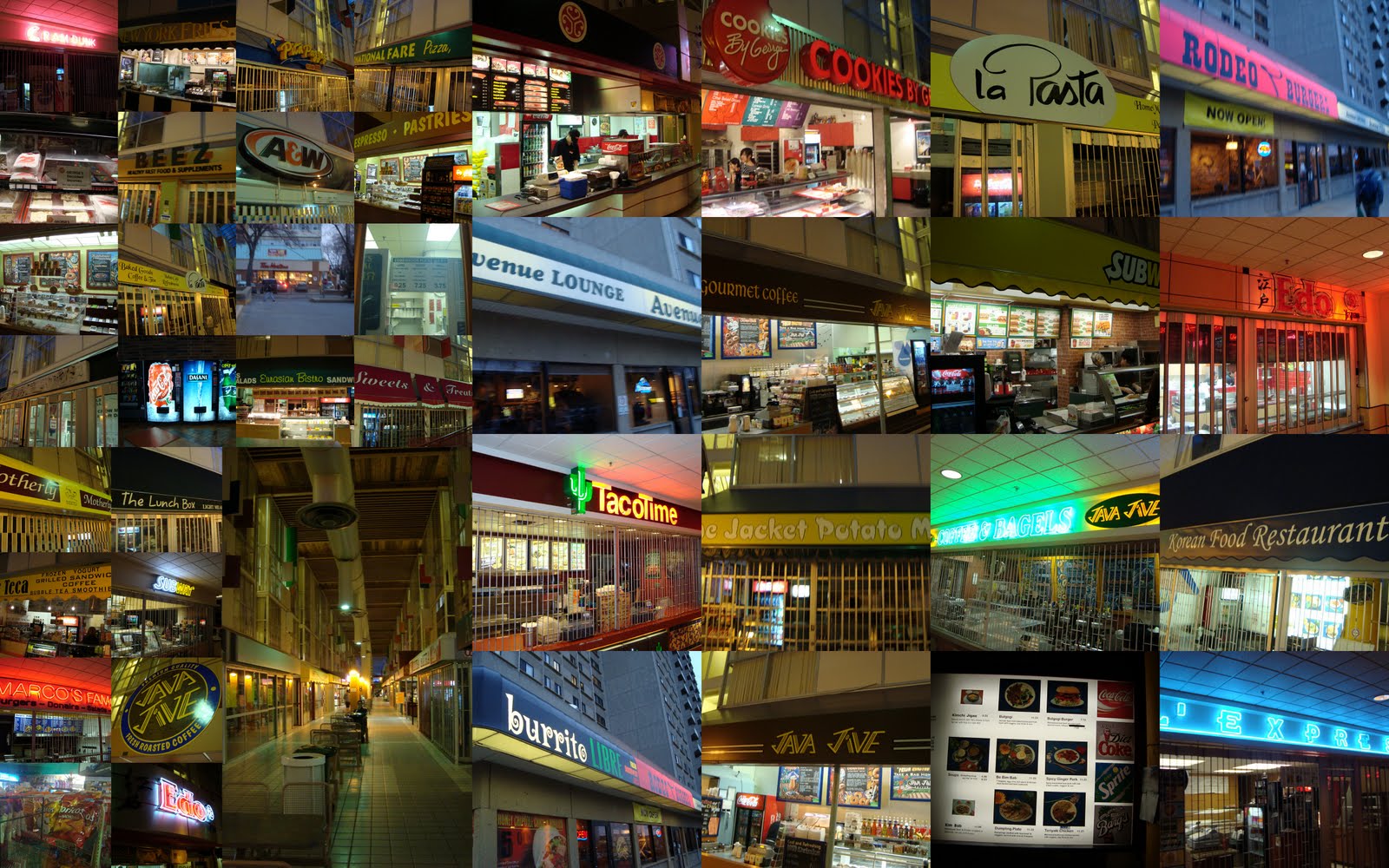
I went around HUB, 112th street, and SUB to find out what's available for food on campus. Here's a collage of what I found out.

Maybe this is a giveaway considering University of Alberta is a Coke sponsored university, but I was suprised at how much fast food we have in such a small area of the campus where most students buy their lunch or go for snacks.

In HUB Mall Strip, I counted 20 places where food was the primary commodity, and most of the places had fast or junk food being sold. This means that one out of every three shops sold junk food the entire mall.


Here is a collage of the photos from around campus about the "variety" of foods that are available for students to purchase.